To be the wind for the tree is a poetry generator that translates the physiological parameters of your chosen tree into lines. The project is based on the TreeTalker+ sensor, which is designed to monitor trees: it measures the quality of green infrastructure and ecosystem services that trees provide to the city. The generator translates the tree data collected by the sensors in real time into short poetic texts
To be the wind for the tree
To be the sun for the leaves
To be a mineral for the roots
To be a bird or a pollinator insect.
Did you ever want to hear a tree talk? Did you ever want to feel how the water goes up the tree crones? How do the minerals feel for the root hair? How does the wind feel for the tree? This project is based on the idea of the Internet of Trees (IoT) verbalizing the tree sensualities.
In the summer 2020 I felt closer to the trees than ever, because of the induced immobility and because I had time and space to spend with them. The work I am going to discuss in the paper translates the trees readable for the viewer creating vocabulary for the physiological processes that happen inside them: the sap going up the crones, the humidity of the trunk, connected with the humidity of the air and soil, their vertical position in three axes and how the tree feels gravity and wind, the 12 spectra of light the leaves photosynthesythe on. The generated text is based on the data from the Tree Talker sensor developed by the Smart Urban Nature Lab (Moscow).
The concept of To be the wind for the tree, the poetry generator and its prototype were made for the Abandoned gardens section of Pangardenia, a Kepler’s Garden of Ars Electronica, 2020. This project was co-curated by Artur Konstantinov, Laura Elidedt Rodrigues, Anna Kozlova and myself. The festival was inspired by the pandemic sensitivity and the absences it presented the artistic community with. These absences were formulated in the four paths: Parniki (artists kept in their homes, also indoor gardening and other types of “capsulated life”), Abandoned gardens (semi-closed universities and ways for growing knowledge and art in lockdown), Wandering gardens (an artistic boat trip in collaboration with boat drones) and Post (non)human Gardens (new types of life forms, combining both human and non-human agents). The word Pangardenia, as a natural chimera, was chosen as a result of collective voting. It aimed to embrace Panic mindset of the wild and guarded gathering of the garden and gradina, elemental and structural, growing and digital. Pangardenia was depicting life between matter and data. The project united forty artists, four gardens: Botanical Garden of St Petersburg University, Forest Academy, Art Media Center (Academy of Talents, SPb) Garden and ITMO university garden and technological art institutions: Art &Science Centre (of ITMO University), Media Lab of Alexandrinsky Theatre, Faculty of Liberal Arts and Sciences, St Petersburg State University and Kur Future Lab.
The idea of To be the wind for the tree has grown from one of the the abandoned gardens. With a group of Alexandrinsky Theatre Media Lab students we travelled to the Forest Academy where we saw the Tree Talker sensor attached to one of the trees and I thought of materialising its name: making a translation of the physiological parameters of the tree this sensor measures.
The prototype version contained five lines based on the awareness of the physiological parameters and general knowledge of physiology of the tree. The lines were not limited by the word count or any type of material constraints.
the cycle of the year leaves a circle
transformer l’aubier en bois de cœur
stable, I stay
sugars go down the phloem to the roots
round and round
death goes up the tree trunk to grow stable,
I incline south-west
green leaves have enough water
to photosynthesize
round and round
the pith is a seedling inside the old tree
I incline south-west, stable
the soil is warm and moist
round and round
The order of the lines here is not set as in later versions. The first line is a general observation of the physiology of the tree, the second one refers to the thermal probe and the speed of the flow of sap, the third one contemplates the parameters of the accelerometer and the final is always the radial growth – “round and round”.
The first prototype of the work remains on the page of the Abandoned Gardens. Now in the context of immigration after the Ukrainian war the Adandonned Gardens gain additional meaning of abandoned land. Now looking back at the summer of 2020 it seemed natural to film the trailer for the Abandoned Gardens in July in the Botanical Garden of St Petersburg State University, one of the partners of Pangardenia. Two years after in the cold March of 2022 we were filming the opening of one object exhibition first in the library of the Botanical Garden and then in the garden itself. The feeling of the botanical garden in July was of an unnaturally closed summer within summer, in the winter 2022 it was the feeling of unnaturally closed country. Yet the day in the garden gave freedom from the snow.
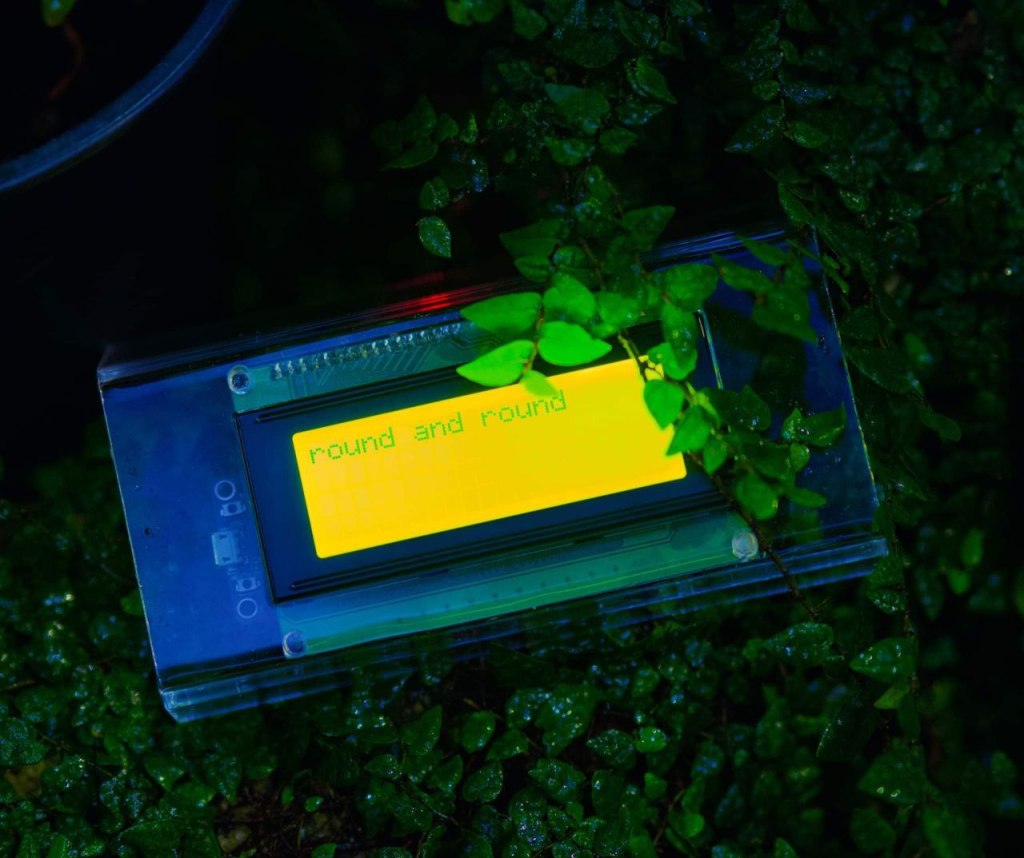
To be the wind for the tree, the portable device, was first presented remotely at Teleported Arts, South Korea on 29 January 2022 because of the pandemic restrictions. The physical object was made in the labs of ITMO University with the help of the engeneer Rostislav Shchtennikov and technical director Alexey Feskov. It consisted of an LED screen, an Arduino in a transparent plastic frame.
The portable device was conceived as a telematic connection between the meaningful space, cluster of the trees and a human. This object itself alludes to a pager, that was used in the 90s to connect to the close ones, and, possibly, a tamagotchi that despite being a machine required attention an care just as a live being. TBWFT was meant to connect two living beings with the help of data collected by the sensors and by the means of interspecies translation. In case of the connection to the tree one is not connected to another mobile subject, but is connected to a space. Connection to the tree shows the conditions of this space.
The standout telephone connects with anyone or anything holding a telephone or an acoustic sensor. In the meantime, telephone comprises of a plethora of devices from the past: a camera, a television set, a mailbox etc. Continuous flows distort the focus and produce noise. TBWFT is a device with a sole purpose of observing a significant tree, that absolutely purposefully does not perform any other functions. Although this type of observation defies visual and shifts the focus inside the tree trunk and leaves. In a way, visual would demonstrate differences, while textual makes space for imagination. And it is the imagination that is legitimised by telematic communication. The distance is bridged, or at least anaesthetised, giving space for a shared sensorium.
round and round
stable very stable
warmer than air
water from the earth
round and round
stable very stable
in my cool shade
water to the leaves
round and round
stable very stable
to absorb the dust
slow sleepy sap
TBWFT portable device was the first working prototype of the artwork, yet it was not based on the realtime data, but on the data collected from an Oak tree in the Summer Garden since June till November of 2020 and analysed by scientist Alexey Yaroslavtsev from the Smart Urban Nature Lab. The reason for this was very practical – the trees do not send much data until the temperature is lower than minus five, hence they are not usually measured during the winter and beginning of spring months in a humid continental climate such the climate in St Petersburg. Since the work was aimed at being demonstrated in the end of January, the data collected before was used. The next decision to make was to chose the period of observation and 2020 season as time more calamitous and thus memorable was chosen. In St Petersburg it was the summer of 2020 when the pandemic restrictions hit the most severely closing concert halls, cinemas, restaurants and hotels. Parks and gardens were the only common spaces open to the public.
So the time of the dataset suddenly was more interesting than the synchronous time. Addressing the pandemic time, made it possible to compare the human’s catastrophic sensitivity to the sensitivity of the oak tree in the Summer Garden, which is located in the densely populated city of St Petersburg. Thus, one of the ways of perceiving the work is remembering one’s own feelings and actions during the pandemic period and comparing them to the perception of the same environment by the tree. The work enables us to contrast our memories of the summer 2020 with the degree of well-being of a particular tree cluster. One of the main goals is to show which parameters of the surrounding urban environment both affect the tree and the human. But possibly the most important goal is to depict the tree cluster as a sentient, self-explanatory, confident actor, as opposed to a pandemic human.
The physical object was first exhibited on 8 February 2022 in the Botanical museum of St Petersburg State University. The show was curated by Diaghilev Contemporary Art Museum. The object was intentionally added to the collection of the art nouveau looking huge papier mache models of flowers of the Herbarium of the Botanical Garden of St Petersburg university. Self-explanatory flowers were shown together with self-explanatory trees.
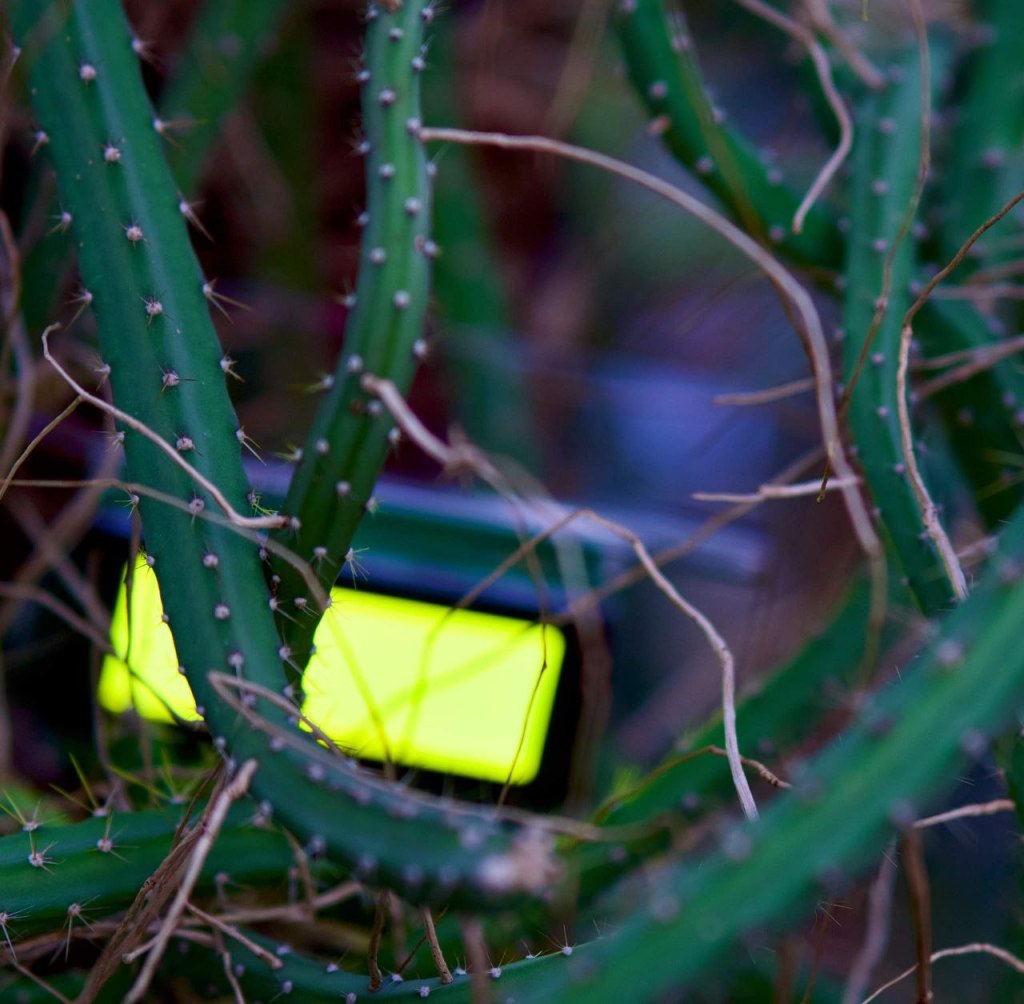
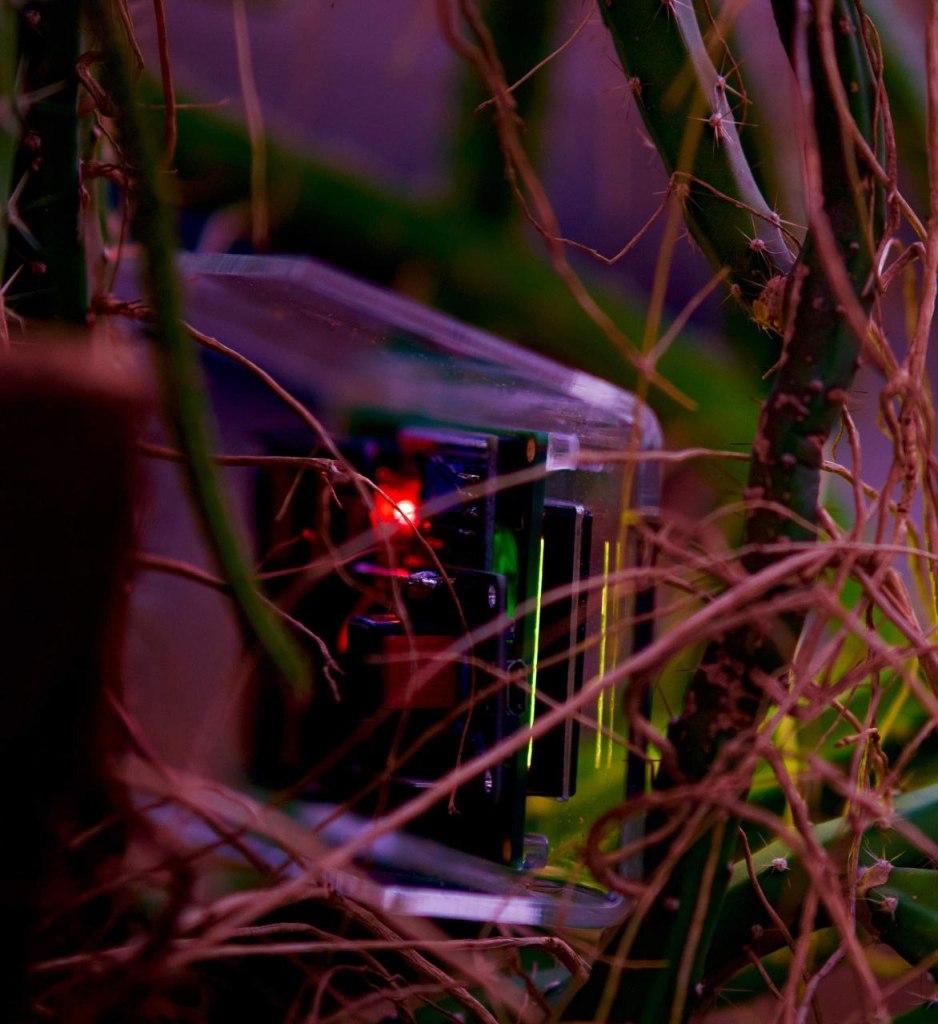
This moment the war in Ukraine started and it felt extremely untimely to speak about the sensitivities of the tree. The surrealism of this situation is reflected in the photographs made by Alexander Antipin that show the transparent box from the most uncanny angle with succulents of unusual shape. That seemed to be the way we felt in this world where our country has thrown itself into a pointless imperial war that was followed by sanctions. None of us in St Petersburg in March 2022 knew how to navigate this world any more.
The next iteration of the portable device took place in Krasnokholmskaya Gallery in Moscow as a part of The space of a message. From a sign to perception organized by artist and curator Elena Demi-dova. This was the exhibition dedicated to 10th anniversary of media poetry lab and included works by VALab, Anna Tolkacheva, Andrey Cherkasov, Daria Gusakova and Oleg Makarov from the first generation of media poetry and media art as well as ITMO Art&Science Centre graduates such as Nadezhda Bey, Ksenia Gorlanova, Alexander Pogrebniak, Sophia Barinova-Osbanova, Anton Shegolev.. In the Russian context media poetry played an important role in the development of the technological art scene, and normalising forms of electronic as well as performance poetry. As someone who played an active role in establishing this field, I felt that TBTFT was in the correct context. I consider the work to be an interspecies translation, yet firmly rooted in the tradition of electronic writing. The lines being the reflections of physiological parameters are also attempts to find the expression for an inhuman sensation exercised by means of tireless algorithm. Some of the iterations are better than the other, yet the text machine continues without a sense of failure.
The last exhibition of the work took place at Coimbra as a part of ELO 2023 dual exhibition Arborescence|| Resistance that addressed social and environmental issues and included more than eighty artists. The show was curated by a collective of curators Daniela Côrtes Maduro, Alex Saum-Pascual, Rui Torres and Manuel Portela. This version of the work was a stand alone device that only needed to be plagued into the electric socket. The abridged version was presented here that included only one hundred measurements, or one hundred glances at the tree. it resulted in more repetitions, the distance between iterations was accelerated. On the one hand, it made the work more meditative, on the other hand, the speed of living the episode of the tree’s life was significantly increased.
.
This presentation explains the work of the generator line by line.
The first line – “round and round”, or “round” in the partitive version or “I wear the annual ring” on the installation crawline indicates the radial growth of the tree. Usually solid tree is more stable and more adapted to the environment. In general, the tree presents the case of reverse aging – the old tree is the most. This line is translating the temporality of the tree. In the six months of measurements the number of the accelerometer remained the same. Although there was a line prepared in case the annual ring would change “time over the edge” in the installation crawline. Mere repetition otherwise creates the connection to the stability of the second line and instability of the European and global history in the years 2020 – 2022. “Round and round” encapsulates the viewer inside the tree trunk and its vegetal mobility by means of occupying space with its physical mass. This line switches from human historical perspective to the autographic perspective (Offenhuber) of the natural season cycle. The events are registered in the body and by the body of the tree.
The tree can protect from the wind, so it is the accelerometer that measures how well the tree stands against the threat of the wind and the threat of fall. And if the tree is unstable, it in turn poses a hazard of collapsing. The lines “stable I am stable”, “stable I incline” “stable I am not”, “stable I will be” are the lines that address this condition. The upright standing as the vital question is an unusual way of being in the world of gravity, yet not completely incomprehensible for the humans. The standing upright is the one healthy and rigorous, the one lying down is sick or resting. For the trees on question falling is even more fatal. Yet the “I” here is the most questionable notion, as even the notion of human subjectivity can be challenged.
Line three, working with the temperature of the trunk and spectrometer, address the ability of the tree to create their own microclimate under the crone which is cooler in the summer and slightly warmer in winter (the tree trunk is never as cold as metal and even wood is not as cold as stone, for instance): “warmer then air”, “take the heat away”, “filtering the sun” or “in my cool shade”, “hades the rain in leaves”, “rain is hard to read”. The leaves not only produce oxygen, but also collect suspended particle matter on their leaves – “to absorb the dust”. “Holding less dust” is one of the transformations that is reflecting the loss of the density of the crone. Some parameters travel from line to line since they correlated, for instance “to photosynthesize” would not appear in November. In this line I also register the ability of the tree to serve as a shelter for humans and wild life – “take my storm inside”, but with the first person perspective it obtains tragic, almost suicidal connotation. I would probably
And, finally, trees can pump the extra water from the soil that prevents water logging of the soil. “draining up my soil” and its variations address this potency of the tree. It is the Garnier thermal probe that measuring the sap flow that allows to collect this data these numbers. In case the speed of the flow is not very high the lined “slow sleepy sap”, in case it is normal – “from roots to crone”, “to photosynthesize”, once the speed reaches the highest numbers the screen reads rather tense “water water water”.
Installation
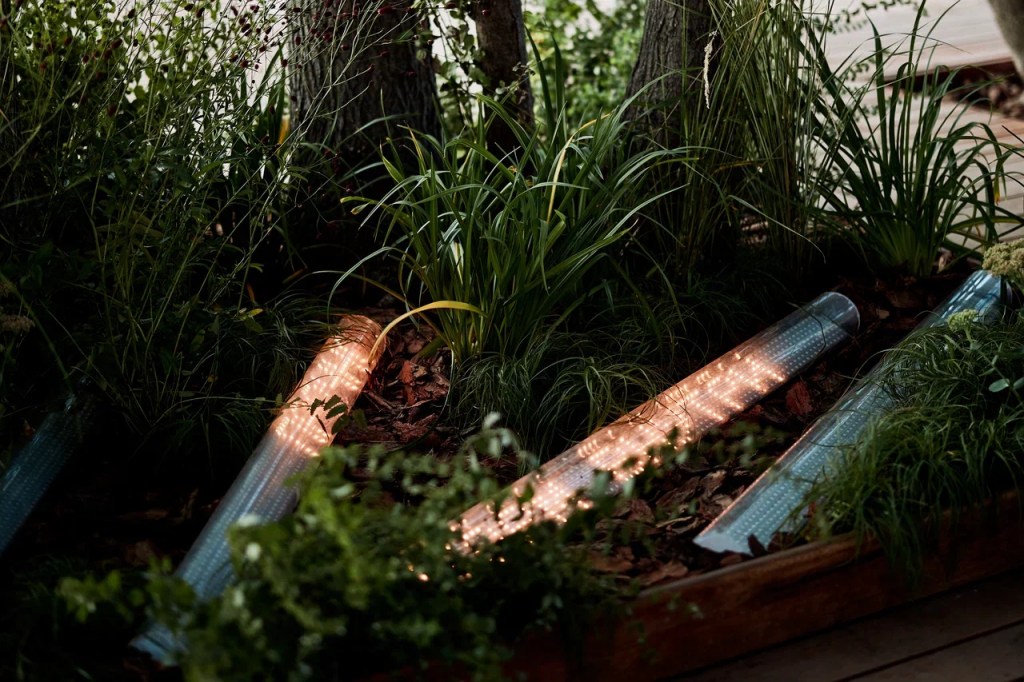
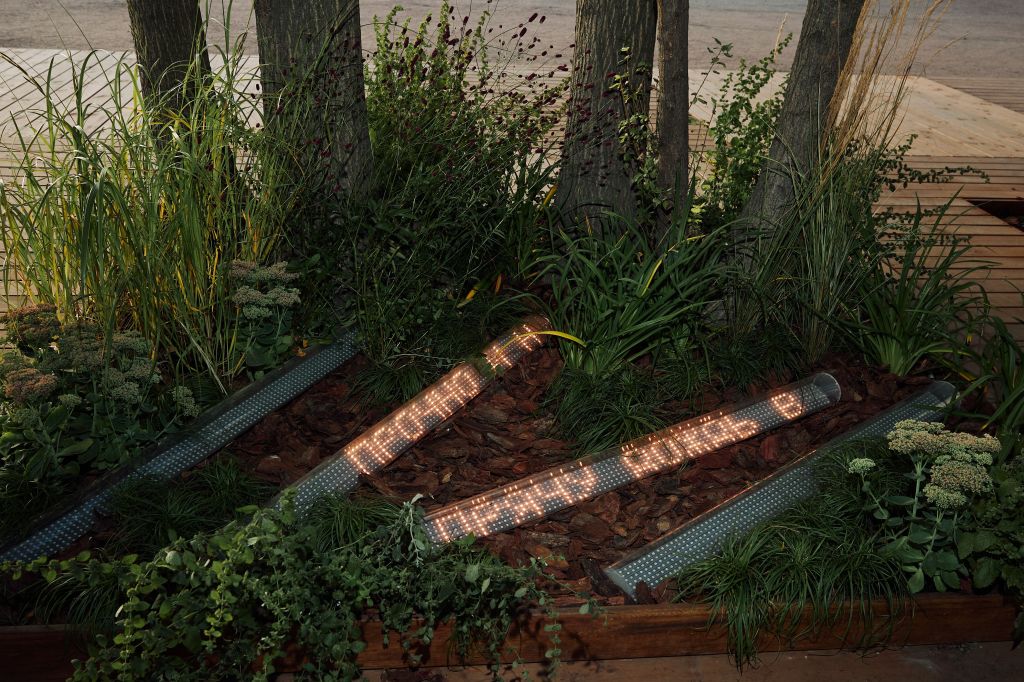
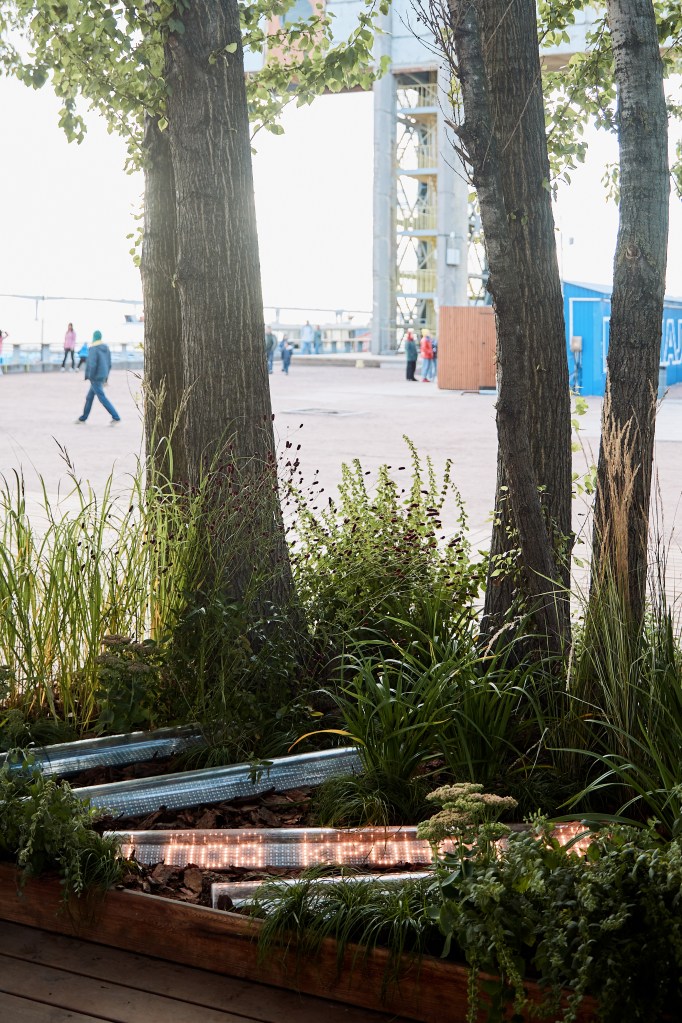
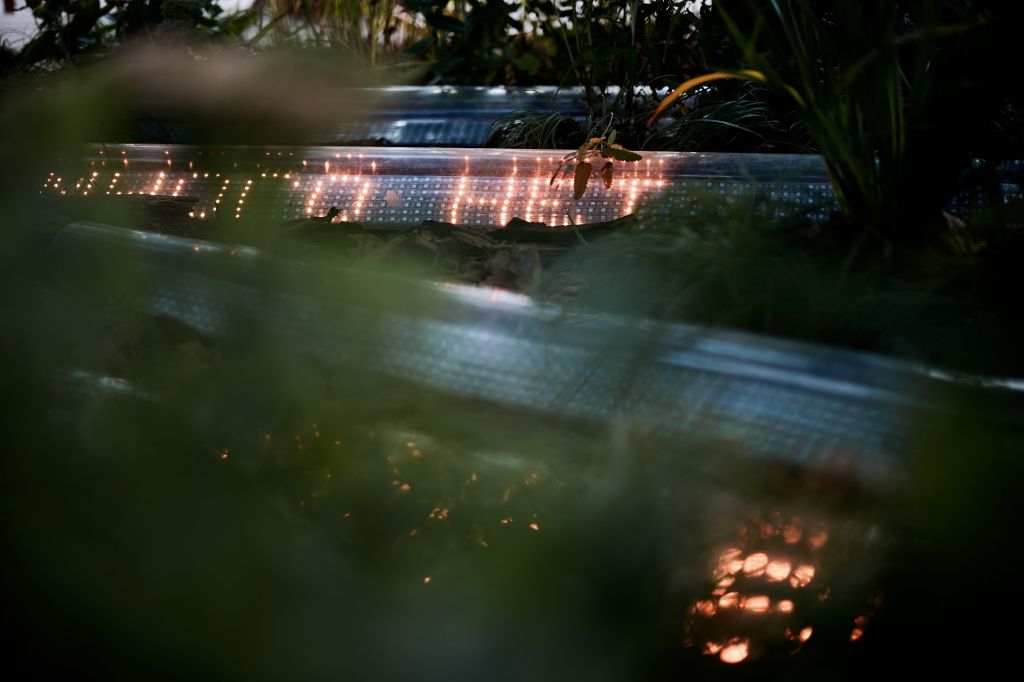
To be the wind for the tree, installation, Sevcabel Port, Rosbank Future Cities festival, 2022
Sevkabel Port is a urbanised industrial area of a former port. It has become a creative cluster since 2017, when the factory moved twenty percent of its production facilities to Kozhevennaya, 39. Rosbank Future Cities 2022 Festival curatorial team (Olga Vad, Kate Gromova and Natalia Nefedova) were approaching multiple venues to discuss the installation including the birch grove near GES 2, few hundred meters away from Kremlin. Yet the final choice was made in favour of the small square of poplar trees in Sevcabel Port. There other works were exhibited in the venue: reGeneration by Maria Kuptsova and Marina Musika’s, Flora Fatalica by Anna Fobia, Biomorphism by Kirill Contre and the site-specific installation of To be the wind for the tree. Festival was held simultaneously in five locations: in Ekaterinburg, Kazan’, Moscow, Samara and St Petersburg. In order to create a shared space in metaverse with the digital doubles of every artwork was created. The viewer in the shape of the chosen avatar is invited to explore the space.
For Sevkabel Port a new shape of the generator was created. Here TBWFT was producing four lines based on data from the TT+ (Tree Talker) device. There were five sensors installed each one on the of the poplar trees of the cluster. The data from the sensors was sent to the server and translated into the four lines of text in Russian. The measurements occurred every half hour. Viewers were able to compare their perception of the environment with that of the poplar trees in real time. Although at the moments of heavy rain once the data form TT was not available the installation was switching to the automatic mode that was based on observations of the similar cluster from the last year.
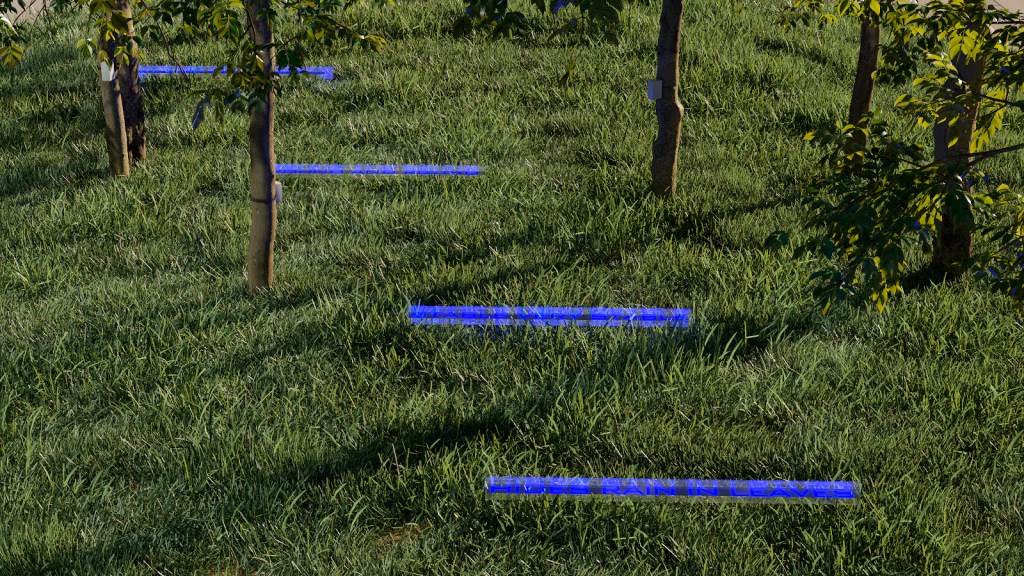
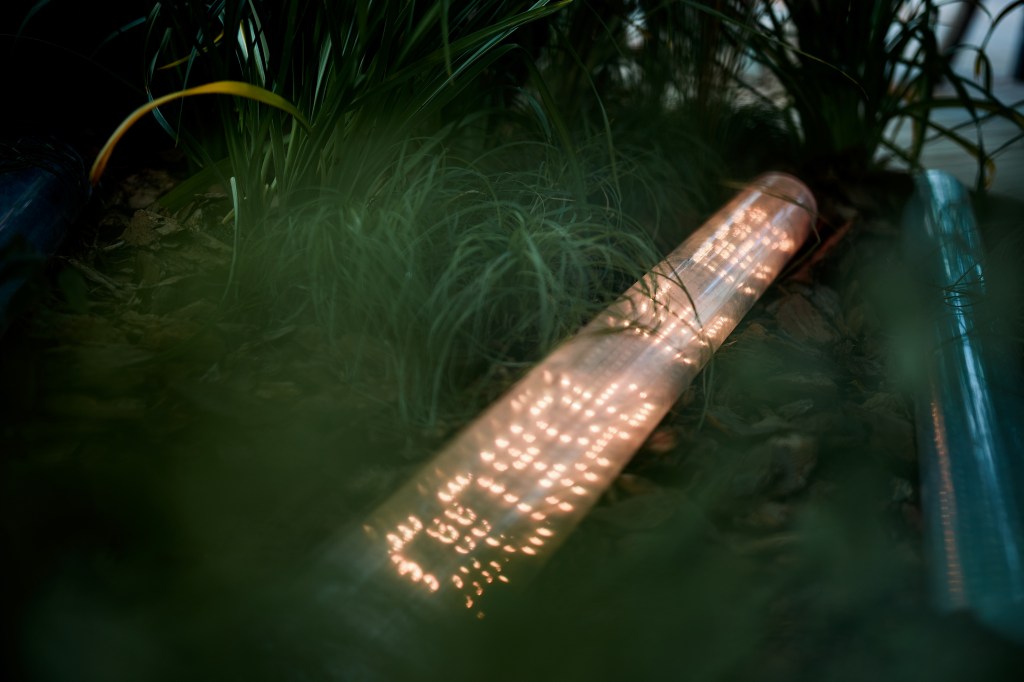
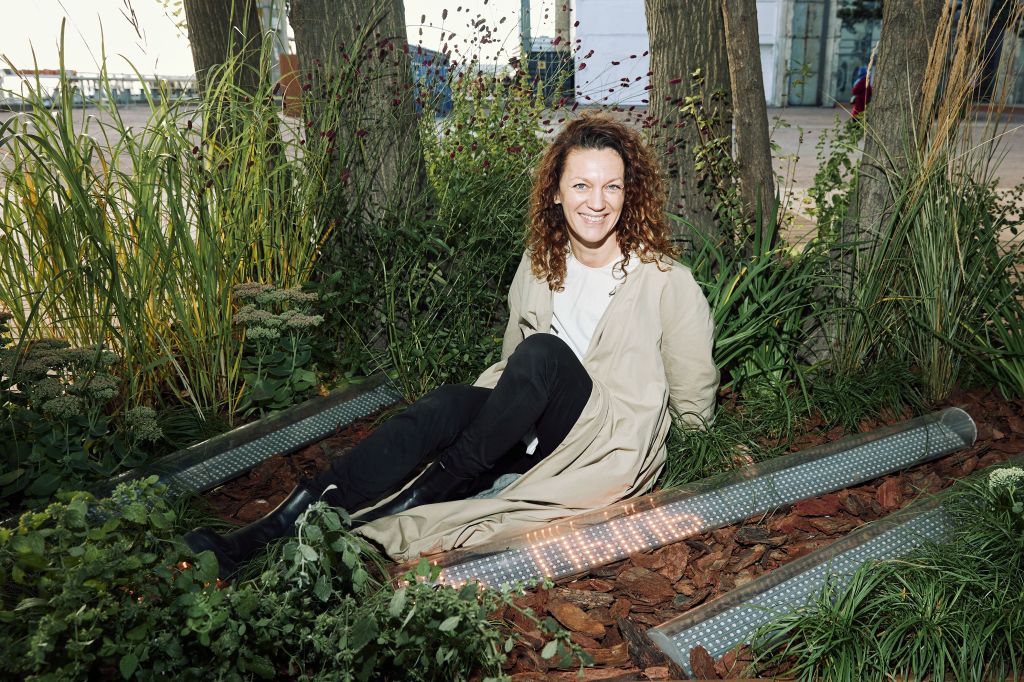
In Sevkabel port each line was encapsulated in a meter and a half long plastic tube. The lines were transcribed on LED stripes. So the verse that was originally on one screen was now taken apart and and could be perceived as separate lines. The length of the line was not important as the text was moving. In the final installation in Peredelkino, legendary Soviet countryside residence of creative workers, the lines in the plastic tubes were taken almost a meter apart. In the Peredelkino version the sensors were connected to the five larch trees, but otherwise the installation was the replica of the Sevkabel version.
Creation of the installation in Sevkabel port was quite a complex enterprise for the reason that it required a lot of preparation to the open air conditions. The installation needed to be made waterproof and ideally working without any interruption for the three weeks of the festival. The cables needed to be hidden, and primarily mulch was used to cover them, and then in the final version high grass was planted instead that gave a much more impressive effect to the installation.
Both site specific installations achieved the idea that was primarily formulated at the Pangardenia prototype, which was to create a vehicle for simultaneous presence of the two sensibilities: the translated perception of the trees in the real time and the sensibility of the viewer. This case of synchronous perception is memorable and quite rare experience even within the same species. The translation of the other stands as a reminder of the fact that the other lives, fights for life, can be read, interpreted form the point of view significant to the other and, thus, possibly, understood.
The next iteration is being prepared in LUMA, Arles, Region Bouche du Rhone and the tree still needs to be determined, but it is likely to be a pine tree since the area is close to the Mediterranean sea and is embraced by the two arms of the Rhone, and this the land is dump and marshy, forming the wetland of Camarque.
This version of the installation includes a metaverse world visitors are invited to explore.
Interspecies Translation Principle
The possibility of interspecies communication is always questionable. In this part I would like to explain what makes me think that the principle I was using is legitimate.
During working on this project I was communicating a lot with dendrologists and foresters. Each one of them said that they do not need any sensors to see the condition of the tree. What they need is time for observation, an intimacy of a sort that they develop with a certain environment the trees are part of. Changes in this environment may include climate and weather, human or pest impact.
My interest to the interspecies communication originates in the desire to read and hear the words, but, possibly, rather signs that do not come from human experience: something that doesn’t come from the umwelt of a creature with four limbs and one head that developed a certain vocabulary of feelings and spreads them in the span of approximately eighty year long life. For some reason, I have always been attracted to these unwritten narratives. Different semiotic system means different time, different points of attention, different habitat. And yet there is something universal to all the living systems: the reaction to the outer environment, the need for nourishment, the instinct to spread and multiply, possibility to from symbiotic relationships and being born and dead.
Interspecies communication is often criticised for its speculative nature: once an entity doesn’t speak for itself any words can be put in its moth, tentacles or leaves. What are the criteria of verification? But I would argue that even human language is not very prone to verification. At this stage the use of sensors and data analytics is a more ubiquitous and more systematic way of observation. Natural environments were probably much more rarely observed in the unfavourable for humans conditions of rain or during the night time. Most of the sensors, including TT take measurements every half an hour during the night and in adverse weather conditions. Although going through the data compared with the weather forecast I noticed that there were glitches on the rainy days. This means that sensors are also less precise in stormy weather. And yet despite this fact, in case carefully gathered and interpreted, the big data of continuous observation by sensors can reveal more and quicker than human observation.
But data itself depends on the purposes of the observer: do they observe to know when to cut the trees or do they observe to prevent the fall of the tree. In case of the TT it is observation of the quality of the green infrastructure that is at stake in the observation process. Green infrastructure is analogous to grey one, the system of pipes, and includes the blue infrastructure (rivers, canals, under earth water) except that it creates a connection between almost equally inconvenient for humans to live nature and city. The European Strategy defines the green infrastructure as “a strategically planned network of natural and semi-natural areas with other environmental features designed and managed to deliver a wide range of ecosystem services. It incorporates green spaces (or blue if aquatic ecosystems are concerned) and other physical features in terrestrial (including coastal) and marine areas. On land, GI is present in rural and urban settings”. So what TT is measuring is the condition of the green infrastructure represented by trees and the ecosystem services it provides. This clearly illustrates in the meta verse version of TBWFT at Sevkabel port.
TT sensor data is a diary of observation that is recorded in numbers. Once you understand what they stand for you can translate this condition in lines. The parameters are interrelated high temperature of the trunk would mean the necessity of water in the trunk. So the raw data is received in numbers that require a formula to count a meaningful parameter. The calculations were performed before the translation process, and present year another stage of translation from numbers to numbers.
The physical form of the portable device and the LED screen we used allowed for four lines of the text 20 signs each, so the lines of the prototype needed to be made much short than initially planned. Also the initial prototype lines based on the seven parameters measured by the TT sensor (water transport inside the plant, diameter growth, quantity and quality of foliage (light transmission in four spectral bands, climate and soil parameters (temperature, humidity), tree stability with gyroscopic sensor, air temperature and humidity, soil temperature and humidity). In the portable device the first line is commenting the radial growth of the tree (“round and round”, “round and”), the second addresses the data of the accelerometer (“stable”, “stable I am”, “stable very stable”, “stable I am not”), the third one interpreted thermal probe (“to absorb the dust”, “take the hear away”), the fourth one describes the spectrometer data (“water up the leaves, to photosynthesize”, “water water water”). As visible from the table the principle of translation in based on the threshold numbers corresponding to high, normal and low.
This simple vocabulary is implemented in the case of my translation from ecosystem services to very primal indicators of living: the annual circle count in the first line, position on the 3D axis – in the second, reaction to the environment (condition of the leaves, temperature of the trunk) – the fourth line.
***
Yet interspecies translation faces the danger of projection, but not less than any other writing outside self, and also within self. TBFT is an attempt to establish non descriptive, but introspective vocabulary for writing with trees. In case of failure of this attempt will pave the road for the non-human literature that listens to and gives voice to other beings. And then instead of genres we would have the nineteenth century museum of natural history of literary texts of choice -– in where there would be a text of every living being.
Both in the case of the portable device and an installation the conditions are set for multiple perception of space. The installation brings forward the different perception of the same environment. And then we are in the thought experiment starting up the imagination and applying it to the other agents in the space to try and reminisce from where they stand. This situation can be seen as a simulator of perception from outside the self. The portable device challenges the notion of space by adding to it a detailed data of the remote one. This causes partial presence at the place that is far, and thus a shared telespace. In other words shared perception may change or build a shared space.

 nataliafedorova.com
Leave a comment