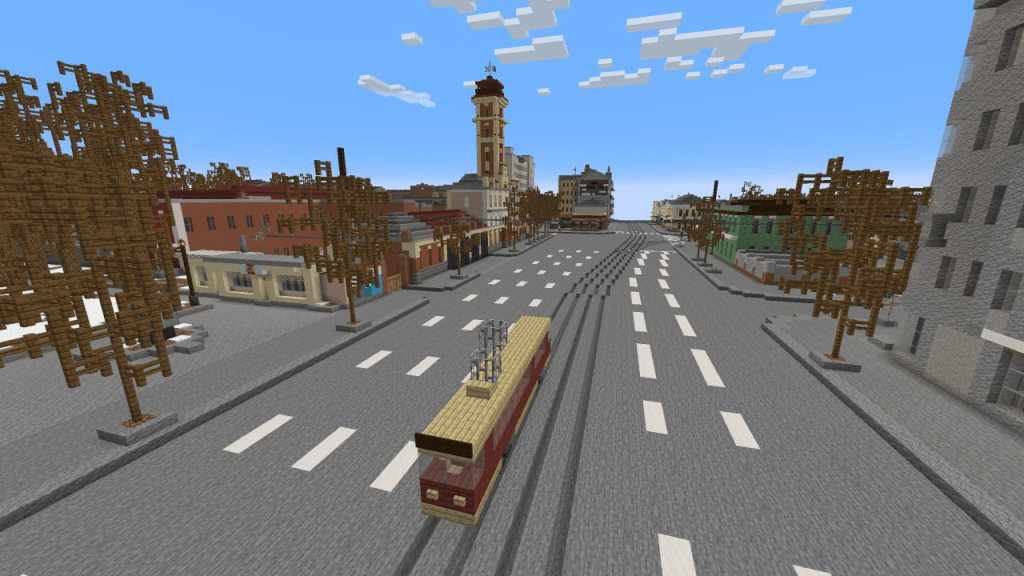
Topography of Destruction is a workshop on reflexive writing and the creation of an interactive VR installation dedicated to sensing destroyed spaces (Kharkiv, Ukraine). We start with by exploring the Minecraft version of Kharkiv to immerse ourselves in the geography of the city before it was touched by the war. At the moment both sides spread unreliable information about the scale of destructions, so we will have to leave it to the imagination of the participants. Participants will be invited to scan significant objects and place them in a specially prepared space. Each participant will tell the story of an object and create a poem based on a poem by Ukrainian author Serhiy Zhadan Remember every house and every street (September 2022), which will be associated with the object in the virtual space. Participants will then experience the destruction of this object. At the very end, participants will be invited to reflect on their feelings about what is lost with the destruction of these significant objects, and how the refugees whose homes and possessions have been destroyed live. The aim of this workshop is to build an empathy machine, to show the world being destroyed, to learn to empathize with someone living in insecurity, to try to understand how to live in insecurity.
The workshop is inspired by Sergei Loznitsa’s Natural History of Destruction, film about the bombing of German civilians by the Allies during the Second World War. It takes a detached look at the unthinkable brutality and absurdity of the destruction of Dresden, along with the ruins of Lübeck and Rostok. The film is based on Sebald’s book, and presents the idea that a passion for destruction is as much a human attribute as love or caring for one’s children.
Bibliography:
W.G.Sebald, Destruction as an Element of Natural History, Actes sud, 2004
S. Loznitsa, A Natural History of Destruction, 2022
D. Shostakovich, The Eighth Quartet, 1960
Video documentation (click on the image):
Possible extension:
Development of an AR app with the objects scanned/produced by the students.
Video documentation (click on the image):
Technical requirements:
Room with seats for 8 people (6 participants max, workshop leader, workshop curator)
- Wi-Fi connection
- Audio speakers/ audio system
- Projector or 6 computers with access to six electric sockets
- Minecraft Java Edition (29 euros)
https://www.minecraft.net/fr-fr/store/minecraft-java-bedrock-edition-pc
- 3 lidar scanners (3 iPhone Pro (12, 13 ou 14) (it is possible that participants own these phones)
- 1 (up to 3, depending on the number of the participants) VR helmet
The team of the workshop
Anna Tolkacheva,
Anna was born in 1985 in Gorky, USSR. She obtained a master’s degree in Applied Informatics and has worked as a senior programmer and researcher in the Computational Linguistic field in Russia and the Netherlands (Google Award grant program). In 2017 Anna obtained a diploma in New Media Art in Rodchenko Art School, Moscow. Anna makes multimedia installations and projects that involve a variety of techniques such as video, VR, interactive objects, code-art, and text. She explores new ways of creating text and accessing it through the new media, non-standard interfaces and controllers. Most of her art-works can be attributed to the emerging field of media-poetry. Anna’s art works participated in a big number of exhibitions, screenings, and festivals inside and outside of Russia. VR work, Arctic Recall, won in VR work in progress competition of the 2022 GoEast film festival. Video work, The Freedom, won in International Extra Short Film Festival 2014. She got a Grand Prix in the Video Poetry Film Festival ‘The Fifth Leg’ (2012, 2016). She was a visiting artist in a number of art residences such as PolArt in Arctic circle, Norilsk; Cité Internationale Des Arts, Paris; PROGR cultural center, Bern; etc. Currently she lives and works in France.
Natalia Fedorova
Natalia Fedorova is a an artist, curator, researcher and educator in the field of contemporary art and literature. Her work is centred around mediation between the languages of humans, technology and ecosystems.
Natalia’s latest artistic pieces can be classified as interspecies communicators. To be the wind for the treetranslates into poetic lines the physiological processes of trees To bee is a semiotic simulator which allows to create a base for a common human and bee umwelt. She is currently working with philosopher Pierre Cassou-Noguès on a installation, Room for René Descartes, which presents VR technology as an “evil genius” who creates multiple distortions.
Natalia’s curatorial projects combine archaeological and futurological lines of inquiry. If the festival 101. Invisible networks in 2020 was held in Planetarium 1 and was devoted to environmental art, then the pandemic year’s festival 101.Telehaptics considered the possibility and impossibility of transmitting touch over distance. The same year Natalia was co-curating Pangardenia, the Ars Electronica in St Petersburg.
Natalia co-founded the media-poetry group Machine Libertine, (Natalia Fedorova / Taras Mashtalir). Noor, a brain opera with her libretto was presented at ISEA, 2016. Her audio and video poems appeared in TextSound, Rattapallax, LIT magazine, and Ill-Tempered Rubyist, räume für notizen | rooms for notes as well as number of international festivals and biennales (ISEA 2016, ELO 2015, 6th Moscow Biennale of Contemporary Art, Manifesta 10, Krasnoyarsk Book Culture Fair, REVERSE, Moscow Book Festival, E-Poetry, LUMEN EX, Interrupt II, VideoBardo, Liberated Words, Tarp and others).
Natalia holds a PhD in literary theory from Herzen State University (St-Petersburg). Natalia won a Fulbright scholarship to do her first year postdoctorate term at the Trope Tank at MIT, where she was working on translating e-lit, and SPIRE to develop Russian Electronic Literature Collection in a specialised knowledge base at the University of Bergen for her second year term. For the last ten years Natalia has been teaching at the Faculty of Liberal Arts and Sciences (Bard College, Upstate New York) and at the Art&Science program of ITMO University. Currently Natalia a guest researcher at the Laboratory for the Logics of Contemporary Philosophy at the Paris 8 University, supported by program PAUSE. She is teaching two courses in Smolny Beyond Borders and is working on an art project as a TSI (Threatened Scholar Initiative) at LUMA Foundation (Arles, France).
 nataliafedorova.com
Leave a comment