Book project summary
Machines to be Another, Chapter 4
Machines of Destruction, Chapter 1
This book will explore empathetic and embodied algorithmic art, bioart and simulated digital and robotic environments. These machines explain people to themselves being reflections of either human behaviour or mental patterns as humans are fixed and crystallised in every machine (Simondon). Machines to be Another highlights the artworks in the recent quarter of the century that explore empathetic communication through embodied experiences. The experiences can include empathetic communication done with a variety of others (other human, other non-human living creature, other meteorological event) or narration of the possible interactions. These interactions take two poles: machines of affection that allow one to permeate the other’s personal boundaries and machines of destruction breaking one’s own boundaries.
Content
The introduction provides an art historical context to the studies of machine art. Machine as an aesthetic form was envisaged in 1934 at Philipp Johnson’s exhibition Machine Art at MoMA, which included manufactured products – bearings, springs, pots and pans, and scientific instruments – displayed on pedestals. A historic panorama of the machine art was later created in 1968 by Pontus Hulten in his MoMA exhibition Machine as seen in the end of mechanical age.The exhibition combined references to Hero of Alexandria, Leonardo’s drawings, caricatures of steam machines, contemporary racing cars and works by Vladimir Tatlin, Naum Gabo, Bob Rauschenberg, Jean Tinquely, Takis and others. German art historian Andreas Broeckman summarises four concepts of the machine formulated in the last century. The first and most obvious would be the Archimedean classic machine (Gotthard Günter), it implies taking in the raw material and performing repetitive operations on it with a predictable result, such as a conveyor belt or a car. The second concept is an entanglement of human and mechanistic and it is the mega machine (a city, for instance) formulated by Lewis Mumford. Chilean biologist and cybernetician Humberto Maturana and his colleague Fransisco Varela described living beings as autopoetic machines. Felix Guattari and Gilles Deleuze took this understanding of the autopoetic self-production and reproduction and applied it to psychological contexts through the concept of “desiring machines”, and then to a number of social, technical, and psychological phenomena. The autopoetic machine should be taken into consideration always already together with the autodestructive machine (which Broeckman doesn’t mention, but it is essential to this project), that can be formulated in lines with Gustav Metzger Autodestructive Art Manifesto and implemented to the work of Jean Tinquely and Survival Research Labs. Another machine characteristic of unproductive repetition is machine celibataire, which takes raw material and produces repetitive operations, but assembles no tangible result; akin to this would be a machine of desire only leading to more desires. Alan Turing proposes the fourth type – the universal machine that can break down any problem into smaller operations solvable mathematically, thus introducing the project of a contemporary computer and even further, artificial intelligence. Cybernetic machine (such as Black Box by Claude Shannon or Soliloquy of Mobiles by Gordon Pask), a mechanism or aesthetic potential environment (Pask), despite its origin in military-industrial complex, led the way to contemporary empathy machines.
Communication and sending messages over distance is another implementation of the universal machine, which takesour voices, faces, and words as raw material and sends them to the provider’s server, then to the remote server, then through cables to the server another provider’s server, and finally to the receiver, producing online communication, exchange, staying in touch, solitude, and depression. Previous crisis of physical movement of humans, COVID, has offered a staple tool for connecting people digitally—video conferencing. We all know the shortcomings of telecommunication. The communication machines (as well as other apparatuses) need to produce empathy and have empathy training interfaces within them. Ingo Niermann prophetsies that it is the lovers that will replace the proletariat as a new revolutionary class, but then one must understand love as work to master it: “the Army of Love could enhance our empathy, libido, attractiveness and devotion by exercising through drills, voluntary reinforced by technological means such as direct brain transmissions of feelings, genetic engineering and plastic surgery”. Machines to be Another are machines that enhance empathetic perception, if the ultimate love robot for Niermans is the ocean, I would expend it to the fog, the clouds and the storm (see Chapter 1).
The above-mentioned concepts of machine slide between technical, sociological and metaphorical meanings. In our study of machine as a tool for perceiving the other, we will looking at machine as the apparatus of techno-bodily production (Haraway), material-semiotic arrangements of human and nonhuman entities as well as practices through which organisms are produced. In other words, we look into machines to learn about human and non human entanglements. It is especially important to maintain a critical perspective when examining various care and intimacy robotic projects (androids, robotic pets and caring or communicational environments). Karen Barad points out that it is the apparatuses that create the boundaries between what matters and what is excluded from mattering. This difference is “non-indifference“ (Levinas), or, not unlike Grant Bollemer suggests, it is through acknowledging the difference we acknowledge responsibility by means of making connections and commitments. It would not be an exaggeration to state that the very nature of materiality is entanglement and matter itself is always already open to, or rather entangled with, the ‘Other.’ Consequently, as Barad demonstrates, ‘we’ are always responsible to the Other with whom ‘we’ are entangled.
Bearing in mind feminist, posthumanist (and also utopian) ethical perspective, I will examine technological art of the last quarter-century through the lens of machines of affection and machines of destructions. Perceptually, these two can be connected as machines of empathy. Both intense pleasure and intense destruction cause a projection of self necessary for empathetic perception. It is known that the same part of the brain is responsible for both pleasure and pain, and they shape experiences equally strongly. The intense pain of the other, be it a human, animal, or machine, causes compassion towards one’s own fragile self, known as cathartic projection. Affection is built through repeated connection or exposure to a phenomenon or an entity. In both cases, einfühlung (feeling into, or empathy) occurs through emotional proximity. Thus, the empathy machine would be the ultimate form of the communication machine, one that not only sends and receives the messages over distance but also creates the conditions for their emphatic perception.
The perception of empathy is not univocal. For instance, inn the Empathy Machines article Grant Bollemer advocates for radical compassion industry as opposed to “empathy industry” of first-person narratives. Radical compassion, instead of eliminating differences through ‘feeling-into’ the experience of the other, contrasts and respects the differences that cherish the other’s experience. In my opinion, the other is equally present in the empathic and compassionate experiences and the danger of appropriating the other seems to be too remote: if one feels the same as the other, the experience of appropriation would mirror the experience of appropriation of self. Also, it is highly unlikely that one would express violence or lack of care to someone akin to self. Thus, while the predicate of Bollemer’s reflections is convincing, the conclusion is not. Additionally, the practice of experimental artistic works and industry are not comparable and cannot be placed on the same plane. In this book, we mostly discuss the empathy machine as a communication machine, which simply disproves even the predicate of appropriation of the other.
Yet the book is interested in how the production of affect is structured either through the experience of a body of another shape or of another sort. Different bodies sense differently. The experience of being in a different body can be achieved by delegating control over one’s body to a robotic entity (Inferno or Gravitational Bodies). Another form of altering bodily perception is the replacement of ‘the real environment’ with a simulated environment, as done in VR. This experience is staged through an unusual point of view on the existing reality (person with bipolar disorder, chair, bat, person of the opposite sex, homosexual, etc.) or through altering physical reality such as weather (Nemo Observatorium, cloud machines, fog machines). Disembodiment is characteristic of the machines of destruction and may be empathised by demonstrating or imitating parts of human or animal bodies (Survival Research Labs, Jean Tinguely) or flesh-like visceral substances (My Red Motherland, I Cannot Help Myself).
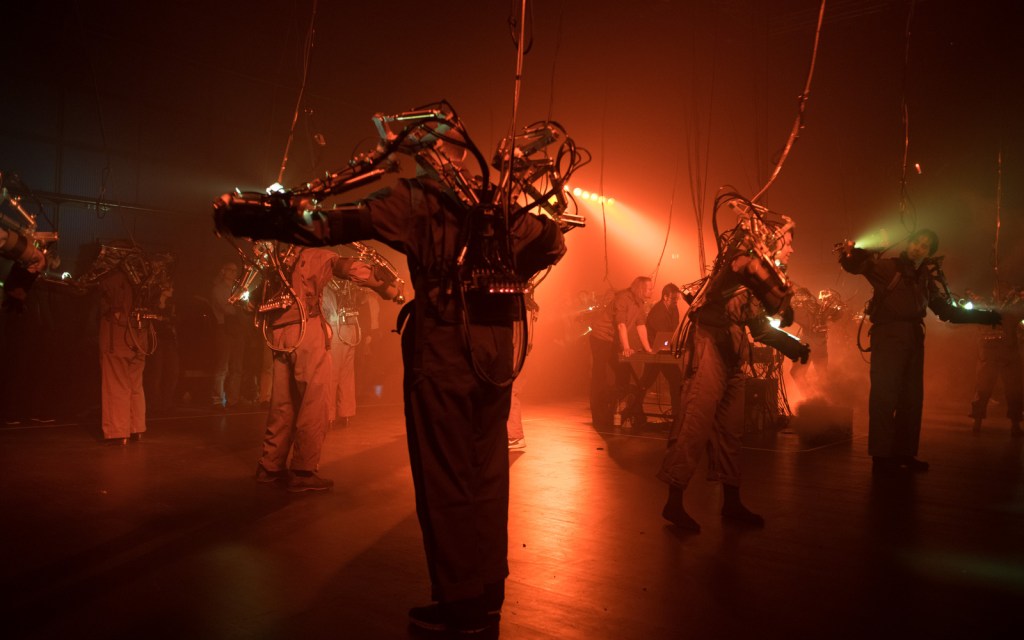
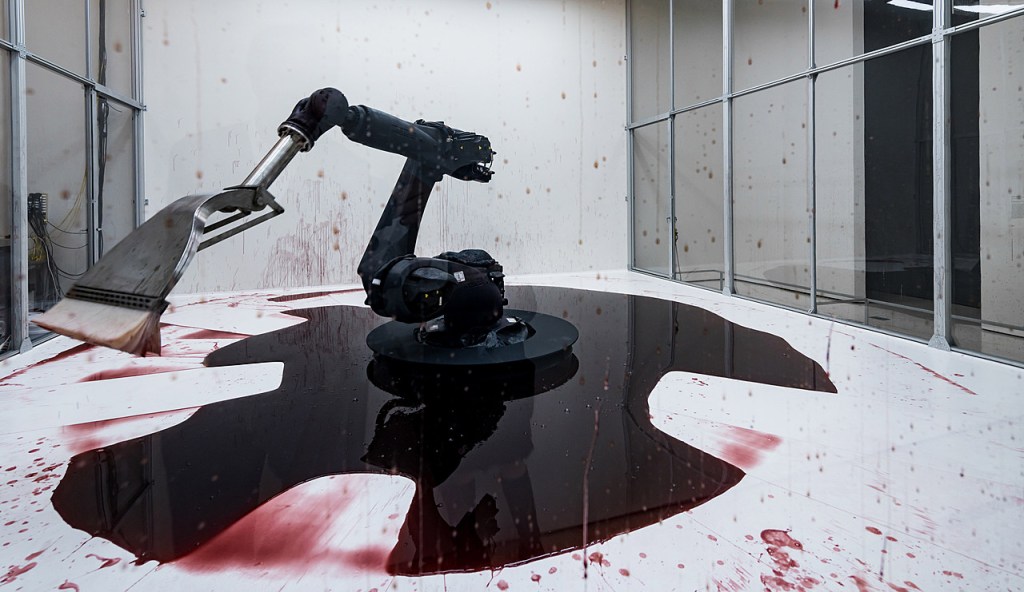
The First Chapter of the book discusses the examples of machines of affection through correlation between the perception of the viewer’s body and the perception of visceral bodily substances particularly in the context of installation and robotic art. Robots have neither blood nor flesh, yet they can manipulate flesh like substances as in My Red Motherland of Anish Kapoor or I Cannot Help Myself of Sun Yuan and Peng Yu; this intrinsically horrifies, forcefully reminding viewers of an act of violence. Other type of machines that is included here are the weather machines such as Cloud Canyons by David Medalla, fog environments by Fujiko Nakaja, cloud machines of Marie Luce Nadal, Rain Room by Random international or Living Dog Among Dead Lions by Vachiko Chachkiani, and storm as in Nemo Observatorium by Lawrence Malstaf. Building on these examples, the chapter explores how installation art can create an aesthetic potential environment that fosters affective empathy—the ability to perceive and express emotions. Works like Anish Kapoor’s red sculptures invite the viewer into the “body” of the artwork, encouraging them to share in the pain and experiences of the sculptural forms. The Sun Yuan and Peng Yu installation I Cannot Help Myself takes this further, using a robotic arm to manipulate a viscous, blood-like liquid in a way that evokes a sense of danger and detachment from the suffering of the “other”.
The Second Chapter explores the paradox of the empathetic potential of helpless and auto-destructive machines that evoke cathartic projection by triggering sensations, feelings and emotions in the viewer’s eyes. The experiencer feels sorry for the failing machine of destruction in the same way they would feel sorry for a failing animal or a human. The text explores the works of artists such as Jean Tinguely, Simon Penny, Lois Philippe Demers and Survival Research Labs (SRL). They show crippled, malfunctioning, hysteric, bearing traces of destruction or auto destructive machines, opposing to the the aesthetics of regular, clean and polished machinery. These machines model conflict and destruction and serve as replacement for a living creature in restagings of the act of sacrifice. Tinguely’s auto-destructive machines, often created from salvaged materials, are dirty, unfinished, ironic and later ( in Totendanz) serve as a critique of mass genocide and destruction caused by war. DSM-VI (2012), the installation staged creatures expressing symptoms of “abnormal” psychological behaviors and afflicted with serious “mental health” problems, such as neurosis, psychosis, personality disorders, paranoia, schizophrenia, depression, delirium, and other forms of behavior and mental disorders. (The project title was inspired by reference manual published by the American Psychiatric Association, the DSM-IV).
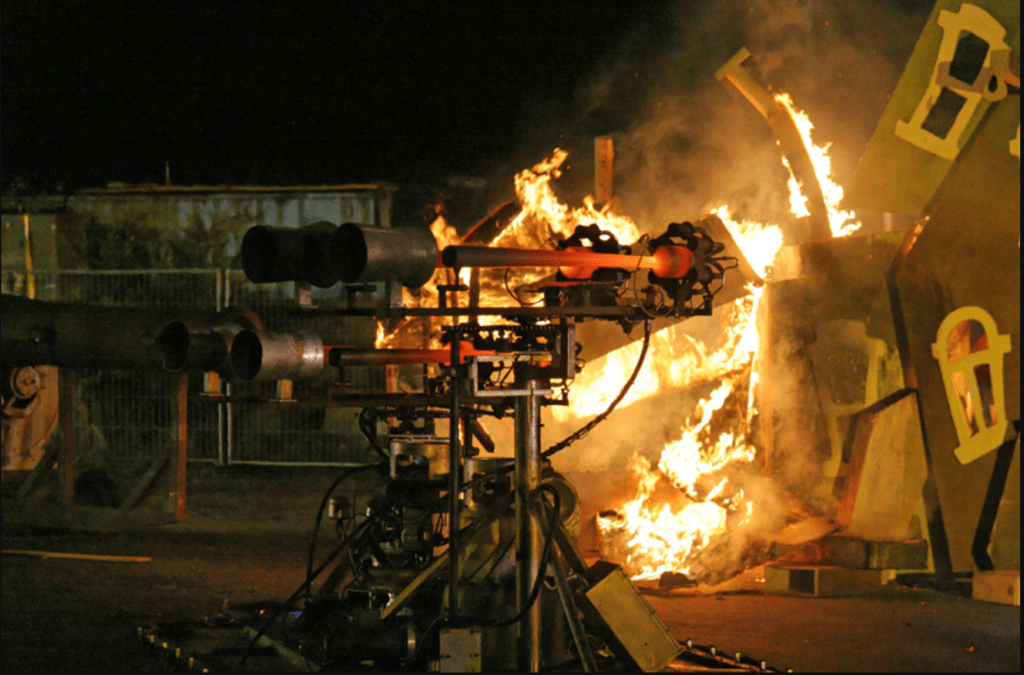
Meanwhile, SRL’s performances combine spectacle and satire to explore the relationship between technology, violence, and the human psyche, often employing pyrotechnics and mechanical contraptions to create a sense of awe and unease. The ultimate spectacle is the fire and explosion, as well as in the tragedy the death of the character. Fire is both bright and visceral, it has a hypnotic aspect to it that is hard to resist. The Study of the End of the World by Jean Tinguely stages a phantasmagoric explosion as a statement about the nuclear experiments, as a statement about overconsumption, but possibly most importantly as a statement about transience.In SRL performances as well as in the Todendanz and the Study of the End of the World the story is apocalyptic: the Last Supper is followed by the Second Coming of Jesus on the jet powered Go Cart. The spectacle is aimed to show the consequences of violence and imbue horror, yet it excites, the way pyrotechnic special effects excite in films. It is hard to imagine the exact properties of noise, the smell and this comic pointlessness of destruction when watching the video footage from the news. The spectacle is the chance to experience a glimpse of destruction without a trauma.
The third chapter explores the paradox of the empathetic potential of helpless and auto-destructive machines that evoke cathartic projection, feeling sorry for the failing of the machines. The text explores the works of artist Jean Tinguely and the performance art group Survival Research Labs (SRL), both of whom utilize machines and technology as a means to express themes of destruction, violence, and the cyclical nature of life and death. Tinguely’s auto-destructive machines, often created from salvaged materials, serve as a critique of industrial civilization and the transience of existence. Meanwhile, SRL’s performances combine spectacle and satire to explore the relationship between technology, violence, and the human psyche, often employing pyrotechnics and mechanical contraptions to create a sense of awe and unease. The text highlights the commonality in both artists’ works, which utilizes destruction and spectacle to challenge the viewer’s perceptions of technology and the human condition.

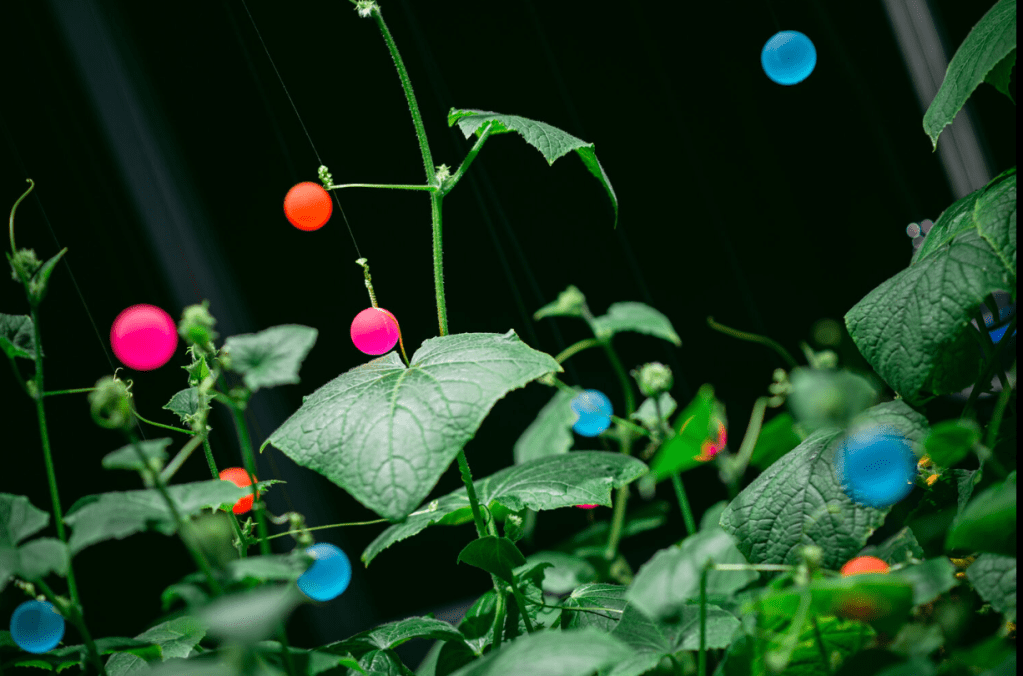
The Third Chapter is a reflection on how critical artistic statement can be created with the help of artificial nature. The selected works will answer the question why contemporary artists use simulated environments and artificial nature. Simulated environment presents a case for a machine of affection. As a rule, artificial nature serves as a model of a natural environment, phenomenon or an activity of a living being. Examples include modelling Earth’s resource distribution (G80 by the Fragmentin collective) or creating a virtual Tokyopopulated by kazokochi – NFT robots named in reference to tamogochi. Similarly, Špela Petric presents a model of an isolated smart greenhouse in Pl’AI. Timothy Thomasson’s I’m Feeling Lucky models something nonexistent: a generalized European or North American landscape generated by a game engine. Anna Ridler’s Circadian Nocturne, based on Carl Linnaeus’s floral clock model, displays exotic night flowers unfolding on massive Times Square screens. Liminal of Pierre Huyghe assembles a model of the universe, and populates that universe with living creatures and images. He makes a hermit crayfish live in a shell shaped like a sleek white Konstantin Brancusi’s Sleeping Muse, reminiscent of a Noh theatre mask.
Artificial nature enables a construction of speculative models and reveals the operating principles of what these models demonstrate: the city, work of international organisations, the principle of counting time. In a speculative model, the principle of its operation, or the algorithm on which it is based, becomes a critical statement. It is the simulated environment based on a particular algorithm that most clearly demonstrates that algorithm. Moreover, these artificial nature models clearly critique the danger of algorithmic reality supplanting physical reality. The slow time of plants teaches the neural network to experience living nature in Špela Petric’s PL’AI work; algorithms play ball with the tendrils of cucumbers to remind viewers that they are as dependent on their gadget screens as plants are on light. The most impressive artificial nature is always the one with the biggest scope, and the biggest scope is Pierre Huyghe’s total installation Liminal. Occupying the entire Punta della Dogana building, it requires hours to experience—offering urbanites an artificial nature retreat. Simondon’s second nature, and artificial nature as part of it, is immersive, it demonstrates the possibilities of algorithms, and it has long occupied the place of natural nature in the life of the urban dweller.
The logic of listing the artworks in the chapter is almost from particular to general: From a model of an average landscape ( I am feeling lucky) to a sketchy failed model of the Earth (G 80), from a failed model to a successful algorithm that thinks it’s a plant (PL’AI), then to an algorithm that obeys flowers (Circadian Nocturne), then to a simulated city populated by NFT robots (Kazokochi, and culminating with a universe model populated by images.
The fourth chapter observes the challenges VR is encountering on the way of becoming the ultimate empathy machine, yet another case of the machine of affection. One of the main moves that is made on this way is transforming the viewer into an empathetic experiencer by merging the plane of events and the plane of the viewer. The position of an experiencer is deliberately made awkward and vulnerable by putting them in an uncomfortable attentional environment. These observations draw primarily from works exhibited at the New Images XR festivals of(2023, 2024). From my female perspective the most unsettling position the director has put me in Traversing the Mist (2022, by Taiwanese director Tung-yen Chou) was being a naked male in a gay sauna. The experiencer is not necessarily a first person primary protagonist as in Goliath (Barry Gene Murphy and May Abdalla, 2021) or Manic VR (Kalina Bertin, 2018), where the unreliable narrator is experiencing schizophrenia and bipolar disorder respectively. In Man Who Couldn’t Leave (Singing Chen, 2022), the first-person observer becomes a cellmate of the protagonist, a victim of Taiwan’s White Terror. Midnight Story (2022, by Antonin Nicless) situates the viewer as an elderly woman at a midnight bus stop, observing lonely passengers awaiting transport. Pigeons create connections between these isolated figures, culminating in a swirling flock that suggests potential harmony among the waiting passengers and the observer. The collective first person narrator can be a space as in From the Main Square (Pedro Harris, 2023). Inspired by Berlin’s evolving landscape and Brazil’s political climate, the narrative follows the conflict between irrational and humanist Rounds and Squares.

Embodied first person perspective with agency is provided in Machines to be Another projects the name of which the book borrows for its title. The view point is destabilised by the body exchange that is at the core of Machines to be Another project. Machine to be Another is a social research project using VR technology as a tool. To be Another Lab (Arthur Tres, Christian Cherene, Daanish Masood, Daniel González Franco, Marte Roel, Philippe Bertrand) ask the research question what would happen if one was able to see the world through the eyes of the other. The project was used for relationships of different nature: be it mother-daughter relationship, a male and a female, people of different race, or different level of disability.
Embodied perception of a simulated 3D environment is at stake of Marnix de Nijs’ Gravitational Bodies that cradles your vulnerable VR body on the emergency stretches, wearing VR glasses and suspended above the floor of the exhibition space floating mid-air on an emergency stretcher with visuals of a perpetually evolving generated landscape. As generated landscape evolves, the stretcher’s position adjusts along X, Y, and Z axes using a flying rig. The experience begins with the virtual camera’s movement matching the stretcher’s transition from standing to reclining, altering the participant’s sense of balance and gravity. In Hospital X Care Unit, Aya Ben Ron creates a medical heterotopia designed as an empathetic attentional environment for first-person accounts of abduction, forced migration, and family violence.
The fifth chapter critically examines the existing soft robots, haptic and telehaptic devises, and sex robots that are described by their creators as machines that enhance sensual perception – essentially machines of affection. In the contemporary art of the last decade, the Robot Love (2018 in Eindhoven, Netherlands) exhibition stands out. The show explored the avenues of possible love between humans and robots and demonstrated a radical acceptance of robots and mechanical devices as meaningful others. While industrial care robots (Paro, Chapit, Pepper, Asimo) had existed since 2010s, Robot Love pushed boundaries by featuring diverse exhibits ranging from explicit sex toys to soft robots in role of emotional furniture (Underneath the skin another skin, 2016) and intimate technologies (Kissing Data, 2018). These included such explicit sex toys and robots as The Flashlight Launch, 2018 by Dutch company Kiiroo, and sex robot Robin by Chinese company Mytenga was performing what she could do and how she felt about it. along with emotional furniture (Objects A, B and C) by Patricia J. Reis for caring interaction. These objects facilitate various forms of bodily engagement: Object A invites the experiencer to hug it, Object B responds to being petted, and Object C actively hugs and comforts the experiencer
Telehaptic devices and telehaptic artwork have advanced the concept of transferable sensation and the possibility of sending and receiving affectionate sensations without physical proximity. These devices inevitably raise the question of which essential elements of affectionate expression can be extracted, transmitted and received as empathetic messages. Telehaptic experiences can present either total or fragmented instance of simulated or transmitted experience. The total artwork in this case would involve either mapping of the sensory motor cortex (Ping body by Stelarc).
Total telehaptic work creates what Kris Paulsen terms telespace – a virtual space where the avatars, images or words of the two or more interlocutors meet. Forums or instant message exchange applications would be the most obvious example of such a place (Paulsen, 2017). However, we no longer perceive them as meeting places since their interfaces have become transparent, unlike in the 70-80, when telecommunication technologies were viewed as new architectures for novel experiences of being together. Today we sense them as markers of separation. Telespace can be mapped so that which distant interlocutors follow the same movement trajectories. In this case an image can be a map of their mutual touch, Merleau-Pontian touch of touch, as well as an intermediary virtual shared space. Touch my Touch by Karen Lancel and Hermen Maat creates an online public space for the purpose of touching remote meaningful others. The interface displays the faces of the caresser and the co-caresser and the face in the middle is a meeting place. A Caresser should touch their face more slowly while monitoring their partner’s corresponding movements via mouse, touchpad or a touchscreen on the central portrait.
Fragmented experience enables remote connection through augmenting one (or more) of the sensory receptors. The augmentation involves either wearing a piece of technology on the surface of the skin, or wearing an implanted sensor (Moon Ribas earthquake sensor). Wearable technology intersect with the field of design (HugShirt, Kissinger), on one hand, and mediated performance (Wodiczko). While implanted sensors remain under the skin until extracted, performance instruments are usually bulky (::vtol:: Reading my body, Last breath) and are instruments created for the occasion of a performance. Wearable device can be a neutral informer or a self-imposed constraint. Loci by VALab exemplifies such neutral informer, wearable sensor that reacts to the movement of the nocturnal animals and transmits the date in the form of vibration to the device on the wrist. Gordan Savicic’s Constraint City city is a corset that leaves painful traces on the performer’s skin when detecting public WiFi signals.
Conclusion summarises the lessons that the empathy machines offer humans about becoming more sympathetic, attentive, and caring. It explores how to imagine less rigid and less exclusive apparatuses of techno-bodily production with differentiating meaning making practices. The first industrial revolution produced the notion of multiplicity and mass, with the development of transportation constructed the global scale. Once established, this scale was applied across different domaines: global terror, global networks, and mass production. The mass scale should be rethought and recalibrated including the relationship with machines, and machines to be another can serve an ethical techno-apparatus of bodily production that helps reshape these relationships.
 nataliafedorova.com
Leave a comment